25

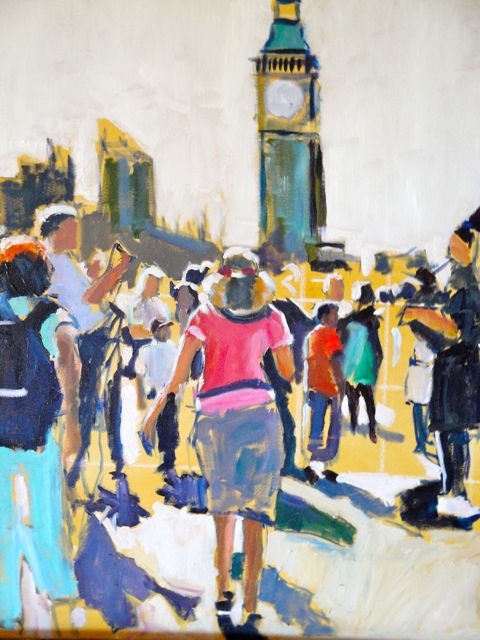
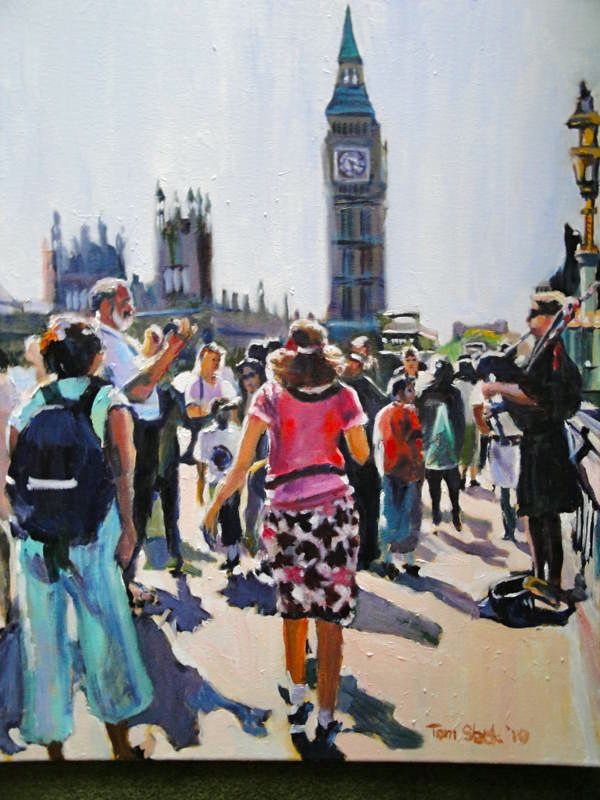
This is the finished painting from my August 31st post entitled “Painting in Progress.” I had been in the hospital for a very long time, nineteen days of which were in the intensive care unit on life support. I have been home now for almost four months. It has been very hard for me to do a painting again. My attention span and motor skills have suffered from my illness. After the horrible experience of almost losing my life, I wanted to paint something that would bring me comfort.

My maternal line is basically Scottish. Mom used to bounce me on her knee and sing a Scottish folk song. Her paternal grandmother was from England. Mom learned the love and tenderness of her grandma. Those British traits were used to raise me. I remembered an experience I had. I was walking over the Westminster Bridge in London when I heard bagpipes. Hearing bagpipes makes me cry. I hurried to where the sound was coming from. A Scotsman was standing there in his kilt playing beautiful melodies. I took video of it. This memory brought all the warmth of my mother’s tender care to me. I had to paint it.

The painting shows the buildings backlit. The people have a highlight on the top of their heads to show they are backlit, too. I have used atmospheric perspective to show depth. To do this, the persons closest are painted larger than the ones further back. The features of their faces are done very simply, because you cannot see the detail in real life when they are in a similar position. I have also tried to portray the gesture of the woman in the center while she walks.
4

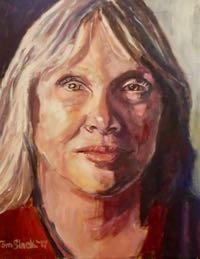
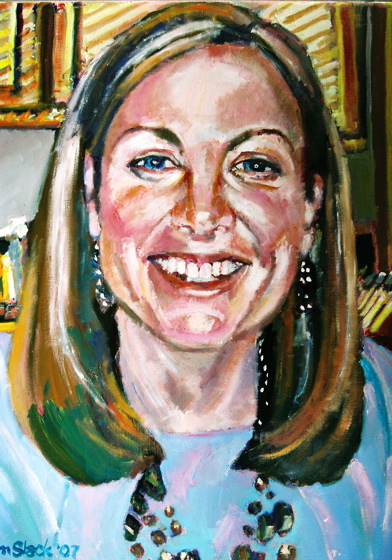
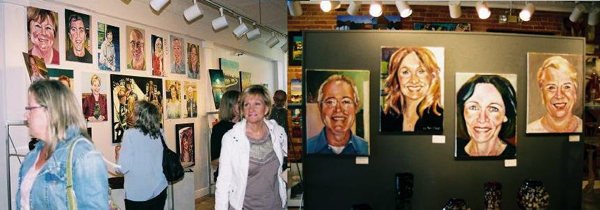
This is one of the portraits Tom painted for his “Northville Who’s Who?” Portrait Show in Northville, Michigan in 2007 at the Sherrus Gallery. He took pictures of well-known individuals in the community, not telling them that they would become portrait subjects in an art gallery show. Imagine their surprise as they walked into Sherrus Gallery, after a special invitation to attend, and found their portraits on the wall! – SF


12

It’s been 4 months since Tom completed a painting. He is still recovering from his surgery, and trying to regain the motor skills necessary to paint. I was thrilled when he sent me this painting in progress! -SF

He said: “This is a painting I’m trying to do. It’s a bridge going over the River Thames (London). The Houses of Parliament are on the other side. On the far right is someone playing the bagpipes. On the left is me taking a video of him.”

4

This is one of my favorite examples of Tom’s expertise in painting light and reflection. -SF

Tom wrote: I asked a musician friend of mine if I could watch him play his bass in a club. I had wanted to do a painting of a jazz combo or other group. He said I could. I took my camera and took several shots.

This painting is supposed to show an afternoon feeling with light  coming in through the slits in the blinds. The piano player has sunlight coming in on his shoulder. Both men have a lighter side on their faces. The bass player’s bald head reflects in the wall behind him. Both heads have a highlight from a light over them. There is a tip glass that was put on the piano. I have used atmospheric perspective. The glass is larger than the people in the background, giving the feeling of depth. You can see light reflecting off the side of it from the blinds, and you can see the bass player’s arm through it. In the bottom is money that has been left for tips.

4

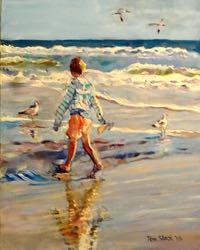
Last week I visited California and watched people playing in the ocean waves. It reminded me of this painting of Tom’s. When you look at it, don’t you get the urge to run and jump in? -SF

Tom wrote: I’ve loved playing in the water my whole life. Nothing is more fun than going to the beach! I painted my nieces, Laci and Kayli, and their brother, Jake, playing in the waves along the Northern California coast.

I’ve tried to create excitement with backlighting. Note the small edge of light on the right side of them, while the rest of their figures are in shadow. I’ve splashed a few waterdrops around along with crashing waves. Kayli is running through the water. The waves above their heads show sunlight shining through them. Trees and shoreline are in the distance. I haven’t put detail in their faces. I wanted the viewer to create those things in their own minds.

3

This is one of Tom’s most beautiful landscapes, with it’s trees and flowers and gorgeous colors! I enjoyed his explanation of how he created atmospheric perspective. -SF

Tom wrote:

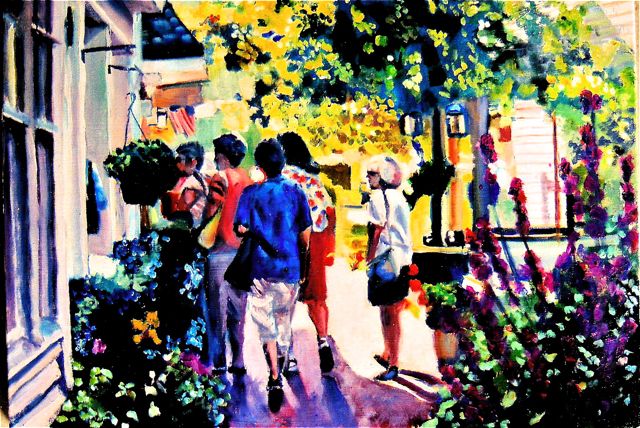
Brown County Indiana is famous as an art colony. In the late 1800s a group of artists settled there. Since then, hundreds of other artists have felt that Brown County was their spiritual home. The town has a charming area with shops, restaurants, hotels and cabins. A favorite place to go is the Artist’s Colony Inn. They have a great restaurant.

One morning I was in the area. As I walked toward the Inn, a group of ladies lined up and went in for breakfast. I was intrigued by the sunlight behind them. The glow of the sun made the leaves in the trees a bright yellow, while the shadow side was blue. The buildings in the shade had a bluish tint and the others were slightly yellow from the sun.

I have tried to duplicate the feeling of that morning. I put the hanging plants and flowers in front of them to create atmospheric perspective. The flags above the woman’s head are painted small, giving the impression they are further back.

3

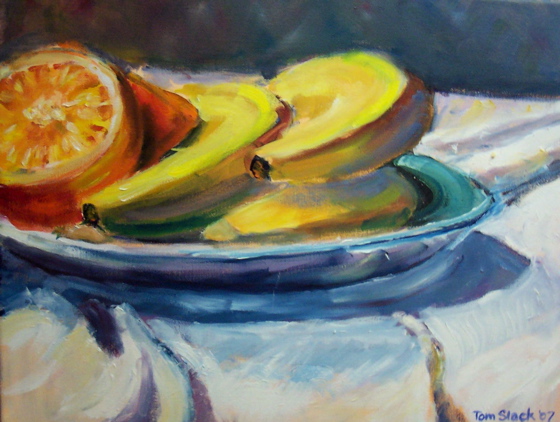
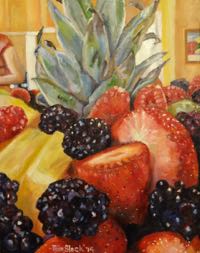
Tom often uses fruit in his still life classes because of their interesting shapes, colors, and shadows. As a class demonstration, he took a simple fruit bowl on a tablecloth and transformed it into this beautiful painting – SF

Tom wrote:

Whenever I do a still life, I light the subject with a lamp so I’ll have shadow and light. I draw the scene on the canvas. I draw each shape I see, like the shapes of shadows or of light. For example, I draw the shadowed areas of the bananas, then the lighted areas. Once the drawing is in, I begin painting. When I paint I don’t think “I’m painting a banana,” instead I think “that shadow shape has a blue tint to it,” so I’ll paint that. Then I might think “there is a blue-green shape” and I’ll paint it, instead of thinking I’m painting the edge of a plate. The cloth is white, but with the yellow light shining on it I use a yellowish tint.  If you think about it, my process is like putting together a puzzle. I paint shapes and colors and they eventually come together as a picture.