15

One of my very favorite places to visit is Madison, Indiana. It is on the banks of the Ohio River just across from Kentucky. It’s main street has one of the largest historic districts in the country. There are dozens of old mansions and store fronts that look the same today as in the nineteenth century. There are art galleries, antique shops and  restaurants. My very favorite one is on a boat that is docked right on the riverbank. I enjoy eating there while looking across the river at the beautiful bluffs in Kentucky.

One of the most famous landmarks in Madison is the fountain on Third Street and Broadway. In this painting, it looks much closer than the vehicles or trees because I have used atmospheric perspective. The figures on the fountain are larger than the vehicles. The fountain is painted over the top of the trees. Both of these things give a feeling of depth. The viewer can feel as though they could walk into the picture. I’ve made the fountain look tall by having it go past the top of the painting. I’ve painted the bottom of the two bowls to create the illusion of looking up.

3

This painting is of the famous fountain on Broadway and Third in Madison, Indiana. It is very famous. It was presented to the Philadelphia Centennial Exposition in 1876 by the Republic of France. Later the Indiana Order of Odd Fellows bought it and gave it to the city of Madison, Indiana.

I’ve always loved seeing  it during the fall when the trees have changed colors. There is a gorgeous church nearby which makes a dramatic background.

The painting has been at the Madison Table Works Gallery and was recently purchased there. I’m always very happy to have my paintings go to a good home.

4

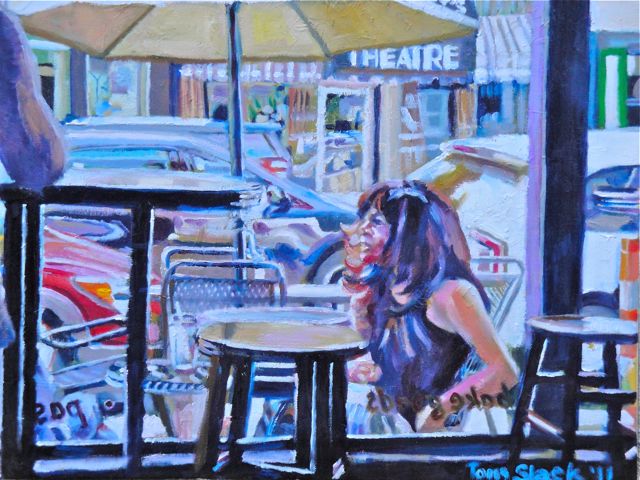
My favorite things to paint are people, cars, and buildings. Recently I was eating lunch with my daughter in a restaurant in Northville, Michigan. As I casually chewed my sandwich, I was struck by the interesting view out the window – the silhouettes of the window frames and tables inside the restaurant. A lady was seated at a table carrying on a very animated conversation with her friend. The wind blew her hair. At the same time, cars passed by. The shops across the road made an interesting background. I was so excited! I knew I needed to try to paint this scene!

The first technique I used is atmospheric perspective. It is done in layers. First I show the interior of the restaurant. You see the silhouettes of window frames and tables. Words are painted on the window. The next layer is the woman. Between her and the cars is the umbrella. The last layer shows the shops across the street. The items in each layer get smaller than the previous, giving a feeling of depth.

I have portrayed reflected light on the window sills, the tables, the cars and the woman’s face and hair. Finally, I have divided everything into shapes and colors.

11

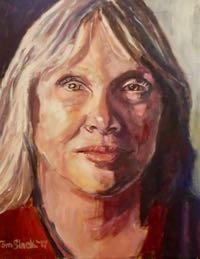
I’ve heard it said that the eyes are the windows of the soul. In my mind, the most important part of any portrait is its eyes. If one looks at someone’s eyes they will see reflections of light on the iris. The “whites” of the eyes are never white. The edge of the bottom eyelid is showing. There are many other things that are apparent. Lips aren’t smooth. Look closely at anyone and their lips will have ridges which have highlights and shadows. These are a couple of things I should mention about this painting.

I had this model next to a window to have natural illumination on half of her face. This was done to show shadow and light and make it more interesting. I wanted to focus on her features, so parts of her head go off the canvas.

The most powerful technique in painting this portrait was emotion. Just as a singer or a pianist put feeling into their performance, I have tried to do the same with my art. Some might argue that I could have a more realistic portrayal with a photograph, but this is art, not a photo.

I love this painting.

12

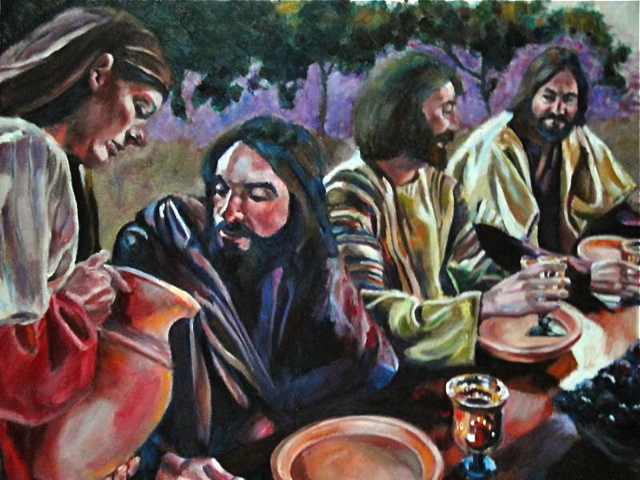
This painting is of the first miracle Jesus performed. You can read about it in John 2:1-11. There was a marriage in the city of Cana in Galillee. Mary, the mother of Jesus was there, and Jesus and his disciples attended. They wanted wine, but Mary told them it was gone. Jesus said, “Woman, what have I to do with thee?  Mine hour is not yet come.”  John 2:4.

Mary told the servants to do whatever Jesus told them to do. He told them to fill six water pots with water, so they filled them to the brim. They took them to the governor of the house. The ruler of the feast, when referring to the wine, was surprised they had saved the best wine for last, since the custom was to serve the best first. He was unaware that Jesus had turned the water into wine.

I wanted to portray the festive feeling of a wedding, so the two men at the right are enjoying a conversation. Mary is showing Jesus that the pitcher of wine is empty. My daughter, Sarah, made the costumes that appear in the painting. She also is the person who portrays Mary. I had three friends come pose for the others.

10

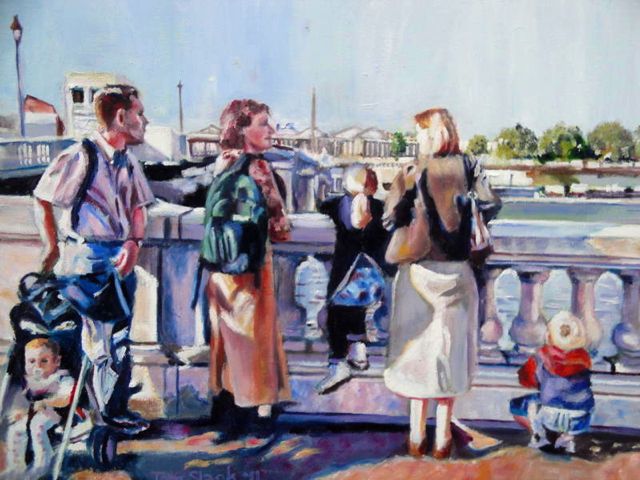
I remember almost a decade ago when Norene and I visited Paris with our son-in-law Will, our daughter Jennifer, and their kids Ashley, Zach, and Natalie. We did all of the fun stuff there. We went up the Eiffel Tower. We ate at outdoor restaurants. I loved seeing the artist’s stalls at Montmartre. We visited the Louvre and Musee d’Orsay. I enjoyed a ride down the Seine. The kids loved to climb all over everything. This painting is of Norene with Will and Jennifer’s family standing along the Seine River.

I’ve tried to portray the sun shining on them. You can see light on their left sides. There is light coming through slits in the bridge. Probably the main thing I have done is painting shapes. Look at the white skirt on Jennifer. It has shapes that are different colors. The whole painting is just a bunch of shapes.

I believe in having fun while painting. That’s what I did with this picture. I just slapped the paint on the canvas. I don’t care what anyone else thinks about it. It’s great as far as I’m concerned.

4


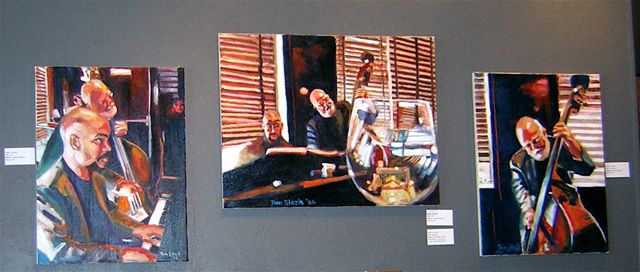
This set of paintings has been sold. I painted them after watching a friend perform in a jazz duo. The musicians and their instruments are highlighted by the reflection of light coming through the blinds on the windows.