1

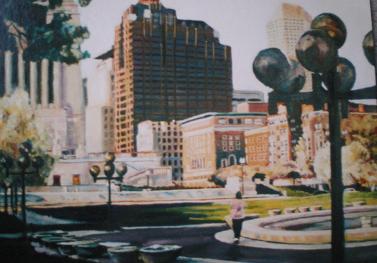
You can follow the woman right into this painting. It has atmospheric and linear perspective which gives the feeling of depth. The streetlights at the front are larger and taller than the ones further away. Leaves are hanging from a tree in the top left corner. They are higher up and larger than the trees in the background. These techniques make it appear that there is depth. Also there is linear perspective. Sidewalks and buildings are wider the closer they are to us, but narrower as they go back.

Another technique used in the painting gives the feeling of morning light. The grass on the left is painted bluish green, giving the feeling of shadow. On the right side it is yellow-green, which looks like sunlight. The large building is light on the left side, but dark bluish on the right. These things make it look like the sunlight is coming from the left.

3

This painting is of a rainy Saturday afternoon in downtown Indianapolis. The person with the umbrella sits in a chair waiting for her ride. The green thing right above her umbrella is the canopy for the entrance to the Hilbert Center where the Indianapolis Symphony plays. In the forties, Frank Sinatra sang in there.

I made it look wet and rainy by painting the light stripes up and down in the sidewalk area giving the impression of reflections from the buildings in the background. Everything seems to fade as you go further back. This is what it looks like when it rains. Also note the linear perspective – the sidewalk is wider on the right than on the left. The car on the right is larger than the one on the left. That is atmospheric perspective. Those techniques give a feeling of depth to the painting.

4

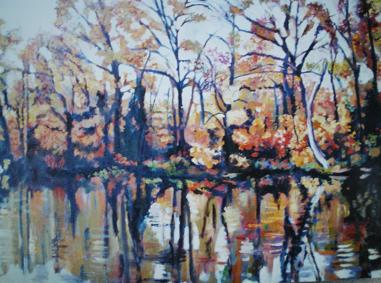
This is a small body of water in Ohio County, Indiana. To do a lake picture you draw a horizon line, then put in the features above it, like the trees and sky. Next, you do a mirror image of them below. There are ripples in water, so just paint small white streaks across the reflected objects. Even better, rub your finger across them to give a distortion that waves or ripples would make. On trunks of trees put in a light side and a shadow side to give depth and shape.

3

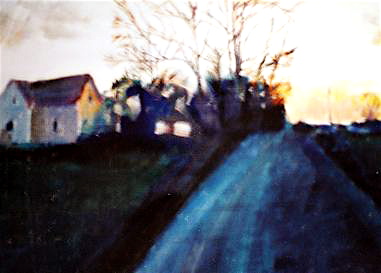
How can you create a look of evening shadow? What can you do to give the feeling of the sun’s glow as it is in the evening sky? It’s simple. Use color.


Look at my painting. It is of a farmhouse on the crest of a hill as the sun is going down. There is a dirt road. I didn’t paint it brown. It is blue. I didn’t paint the fields on either side green, just a deeper shade or value of blue. This tricks your eyes into thinking it is in shadow. The shadow side of the house is a light blue tint.

Now look to see where the sin is glowing. It is yellow. The side of the house with sunlight has a yellow tint. I have left the sky white because the strong sunlight overtakes the blue in the evening. The clouds are just some blots of bluish brown. The tree limbs look lit up. They are painted an orange shade which gives them the illusion of being illuminated by the sun.

1

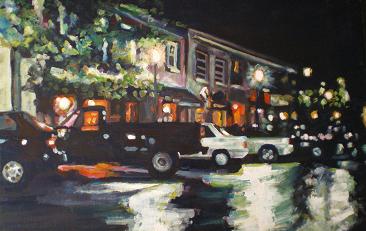
On a rainy night everyone parks along main street and go in to their favorite hangouts to be warm with their buddies. The cars wait outside in their parking stalls. As you look at the night sky, the color is actually black. Lights shine from above on the cars and wet roads beneath them, yet at the same time the walls behind are lit as well. The reflections of the lighted establishments glow. We don’t know what color the car and truck really are. All we really see is black. The buildings in the distance disappear into the night sky.

Filed under Artist Tips by on . 1 Comment#

2

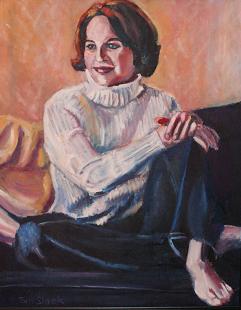
There are different types of portraits — casual, formal, head shots, full length, etc. This one is a casual type. It has a very natural feel to it. She looks like she just sat on the couch, pulled her feet up and got comfortable.

When I do a portrait I try to create a mood. I want to enhance the personality of the subject. Joanna is a warm, sensitive person. The background color reflects that. I have also tried to show reflected colors on her white sweater. She doesn’t look posed. Her expression is as though she is thinking pleasant thoughts.

2

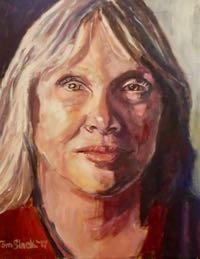
This is a demo I did for painting a portrait. The model is my favorite, my wife. First I draw an oval shape to fit the face in. I draw a line across the center. The eyes will fit on it. Another one is drawn from top to bottom in the center. The nose will be put around it. Halfway between the eye line and the chin will be another line. This is where the bottom of the nose will go. I draw another line, this time halfway between the nose line and the chin. This is the mouth line.

I now know where everything goes. Next, I start drawing shapes of shadows or values — the area over the brow, the shadow under the nose, the upper lip, under the chin. I mix three shades of flesh color, one dark, one medium, one light. I find the dark areas and paint them in: brow, under chin, upper lip, under nose, etc. Next I find the lightest areas and do them: the upper part of the cheek, the part of the forehead and chin facing the light. The rest is painted in with the medium.

I now use other colors as needed. Lips, eyes, hair, etc. The lip is the shiniest part of the face, so I leave a highlight on it, as well as the tip of the nose.

These are the basics.