
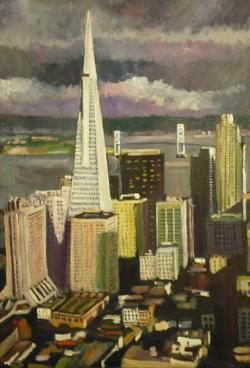
 Grandma had died. I flew to California to be with relatives and attend the funeral. When it was over I felt lost and lonely. My father knew I’d never seen San Francisco. He rented a car. We drove downtown. I loved my dad. It was great to be with him. We ate shrimp at the pier. We rode the cable cars. He and I went up Coit Tower to see the city. We drove down Lombard Street. I bought a souvenir in Chinatown. We went to a hotel on the hill. It had a glass elevator on the outside. We rode it to the top and saw the beautiful city. We went back to the car. It was alone on the road. All the other cars were gone. We had a big traffic ticket. I still missed Grandma, but at least I had my dad. He’s been gone almost twenty years now.
This painting reminds me of him. Note the buildings are like blocks standing on end. I’ve given the feeling of sunlight with shadow on the side. There is a great contrast with the dark clouds over the bay. The bridge stands in the center of the background.
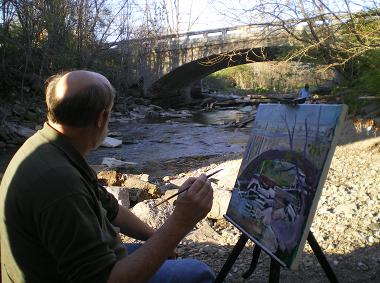 One of the techniques of painting is called “en plein air”. The English translation is “open-air”. It was made very popular by the impressionist painter, Claude Monet. During his day, the accepted forms of painting were of religious, historical or mythical scenes. Landscape paintings painted on site were not common, nor were they acceptable. Monet made them popular. He would paint scenes of the sea, of rivers, his lily pond, and grain stacks in the countryside.
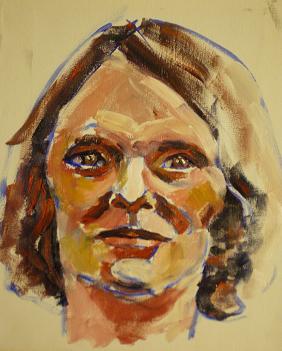 In tonight’s painting class I was going to teach the students how to paint skin color and do faces. I had a painting I had been working on to show them the techniques, but remembered I had a small canvas in the back seat of my car. My wife was in attendance so I asked her to pose while I drew.
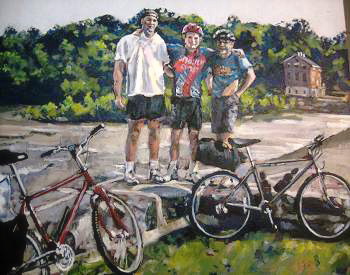 This is a picture of my son-in-law Jeremy and his 2 best friends from high school. They went for a 120 mile bike ride on the C&O canal. They stopped beside one of the locks for a picture. I tried to work from the picture to preserve the memory for him.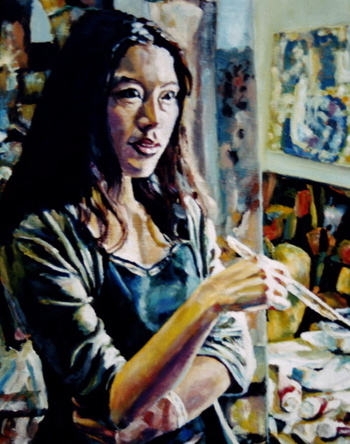
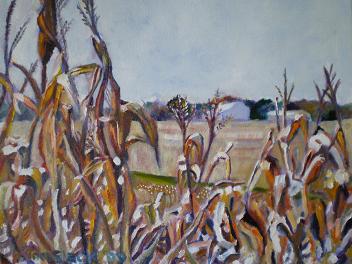 This is the finished product of my previous post “Frustration.” You’ll notice a strong sense of atmospheric perspective – the cornstalks are painted much larger than the barn, and they are painted much sharper while the barn is vague, giving an illusion of depth. The cornstalks on the left go off the canvas, giving a vertical anchor to the picture, while the horizon line gives a horizontal anchor. There is a strong contrast created by the organic shapes of the cornstalks, but the barn is rigid.


Recent Comments