5

Main Street.jpg

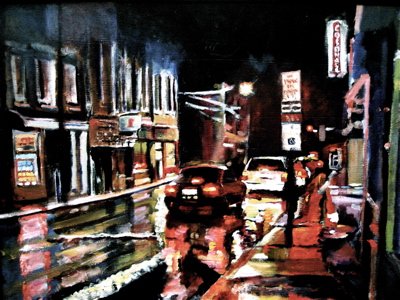
I’ve always loved driving my car during rainy nights.  The reflections in the road are amazing!  This is on Main Street in Greenwood, Indiana.  You see the reflections of taillights and store fronts.  The white car in the front is illuminated by the headlights of the car behind it and the road reflects the back of it.  Red taillights give the sky a reddish glow and the streetlight shines, illuminating the stores on the left.

5

glass_1_1.jpg

A few years ago I was asked to do a slide presentation of my art for a women’s group.  One picture showed  a painting of paint brushes in a mason jar.  A woman in the group asked me where I got “that glass colored paint?”  I had a hard time explaining that there isn’t a “glass colored paint.”

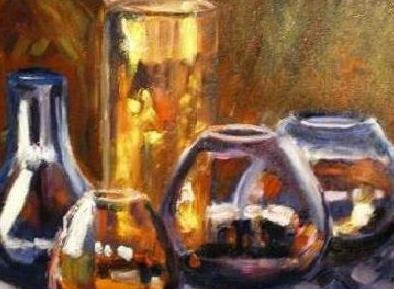
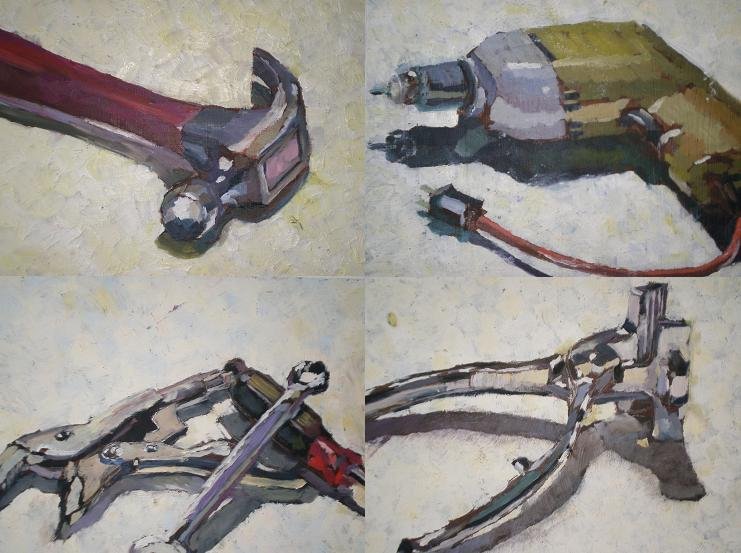
This still life is from my demo at my class tonight.  People tend to be overwhelmed when it comes to painting metal or glass.  I try to explain my method  —  don’t think of it as glass.  Look for shapes and colors.  Draw the shapes you see in the glass, then paint them the color you see.  They come together like a jigsaw puzzle and become glass.  I might mention that I do hardly any blending, but put down colors and leave them how I see them.

4

paoli-street[1].jpg

Paoli is a cute little town in southern Indiana. I like it because there is a road that goes all the way around the city hall. I like to stand on the second story and look down the street. This particular day was very wet. Most people hated the rain, but I absolutely love what a wet road does. It becomes a mirror. I loved trying to paint the reflections. I’ve used two of my favorite techniques to give depth — atmospheric and linear perspective. By having the closer cars bigger than the ones further back, and the greater detail in the front than the back, it gives a feeling of distance. The linear perspective has the road wider at the front and narrower as it goes to the back. Everything merges from a wide angle to a vanishing point at the rear. The viewer can travel in the painting down the road.

6

's Funeral.jpg

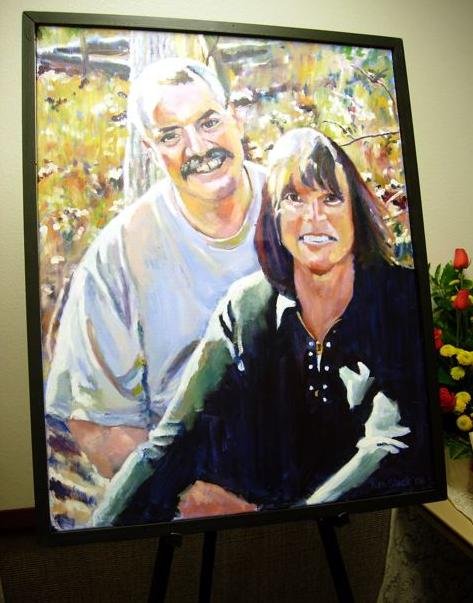
Yesterday was the funeral for my dear brother-in-law, Clyde William Kump.    He died from lung cancer.  His widow, Rene, is only 49 years old.  He has a posterity of children and grandchildren who will miss him.

I visited him in Missouri one last time a few weeks ago and hurried to paint this tribute to him and his wife.  I hope Rene will find comfort in this remembrance.  I put my whole heart and soul into it.

The painting was displayed at his viewing and funeral.

3

portrait-c[1]_1.jpg

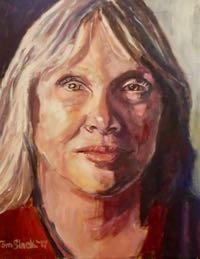
This is a portrait from my last one-man show.  It was mostly the face.  The top and sides of her hair are cut off, giving the emphasis to her facial features.  Note the highlights in her eyes, on her nose, and on her bottom lip.  The cheekbones are emphasised, as well as shadow and light.  The necklace is visable, but not prominent.  I just want you to get to know her.

3

Sunrise on Lake Pisgah2.jpg

There is a magical quality in the early morning of central Indiana.  I love driving through the mist and fog that is collected in lower places.  The sunlight is diffused in a yellow glow as it tries to penetrate through.

This is a painting of Lake Pisgah.  The sun just peeks over the horizon.  You see it twice, in the air and reflected in the water.  The morning mist can be seen in the trees across the lake, and sky and treeline are mirrored above and below the horizon line.  Before the sun gets very high, the sky is a pinkish tone.

6

spring-stroll[1].jpg

I love the spring.  The air is warmer, the birds are singing, and the trees come out in blossom.  This painting combines some of my favorite techniques while showing off the beauty of the season.  I have atmospheric perspective.  The stop sign on the left looks closer than the person on the right because it is painted larger than she is.  There is linear perspective.  The roadway is wider the closer it is to us, then narrows as it goes further.  Both of these techniques give a feeling of depth in the painting.  The shadows and light give the feeling that the sunlight is shining towards us.  If only I could portray the aroma of the blossoms in the tree!

5

Rose Demo.jpg

This is a demo I did of a still life in a recent class I taught.  I always use a tinted canvas.  I find that a white canvas doesn’t show color properly  —  it tends to create a pastel looking painting.  I fill the canvas.  I find the bottom of the scene, then figure where the top will fit, next I measure to see where everything else fits.  I draw the scene quickly, then begin by painting the darkest darks and the lightest lights.  Nothing can go darker or lighter than those.  Next I begin looking for shapes and values.  I don’t try to paint apples, but instead, look for shapes and values that might be on the apple.  I put the shapes together, like a puzzle and they become an apple.  I don’t mix colors, but paint pure colors.  The right side of the rose might be light orange, but the left is a deep red.  I do the same with the stem and leaves.  Next I quickly paint a color in for the background and foreground to make sure it is right.  This is the foundation of my still life painting technique, and it works very well for me.