6

I love Europe. The architecture is fantastic, the art museums are fabulous, and I really enjoy talking to the people there. Probably the thing I like most is walking past sidewalk cafes. It is so much fun to see the people sitting there, eating and talking. Each little cafe has its own atmosphere. I’ve enjoyed painting some of those scenes.
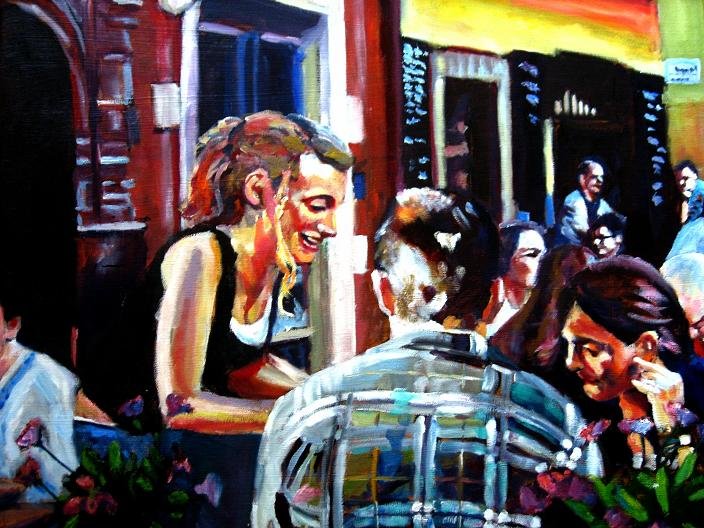
Sidewalk cafe.jpg

This is a cafe in Stockholm. I’ve tried to portray the relaxed feeling of the customers as well as the friendliness of the waitress. The people up close are detailed, while the ones further back don’t have the same coloring or shading. Notice the different skin tones on the three people up close, as well as the light and shadows.

drinks-on-boulevard[1].jpg

This scene is from Montmatre in Paris. I’ve concentrated more on trying to develop personality in the subject’s faces. You can imagine what they may be thinking or saying. In the bottom left corner I’ve painted three people in their own intimate group, while the other two are leaning close together for their private gossip. The top left shows someone in a doorway and to the far right are more customers. If you go to Montmatre you know that many tourists are walking past these people as they sit. Maybe they are what the subjects are talking about.

7

At the very center of downtown Indianapolis is a circle. In the middle of it is a tall structure known as the “Soldiers and Sailors Monument,” so the circle has been named “Monument Circle.”

I’ve wanted to do a painting of the circle for a long time. I knew I needed a view from above. One day I went with my camera to some of the buildings surrounding the circle to see if I could take some pictures. I wasn’t having any luck finding observation decks that were open. Finally I went to the tallest building. I got out my business card and and told the guard at the desk that I was an artist and needed to do a painting of the circle. He told me to go to the various floors and ask the businesses if I could take pictures out of their windows. That is what I did. I liked the view from about halfway up, about the 25th floor. The people were very willing to let me go in their offices for the view.

I wanted to do a large painting. I stretched my own canvas. It is 72″ x 48″. Here I am trying to paint it:

painting-monument-circle[1].jpg

I had to block it in first. You can see the shapes I started with. I painted them separately just so I could tell them apart. I tried to figure out which direction the sun was shining so I could add shadows and light.

monument-circle[1].jpg

Here is the finished product. Note the windows, shadows, and even tiny cars on the circle. It was pretty fun to paint. The only problem was getting a painting this big to the gallery. I don’t remember how I did it, but it’s hanging on their wall.

13

Before the Pilgrims sailed for America on the Mayflower, they moved to Leiden in Holland so they could have religious freedom. After a few years they decided they needed to leave because their children had picked up much of the Dutch culture. They were concerned about preserving their English heritage. They left Leiden to go back to England. From there they sailed to America.

My ancestors were part of that group. They sailed to America on the Mayflower. I was excited when my daughter took my wife and me to visit Leiden where our ancestors lived four hundred years ago. We walked the streets and found where they lived. There is a monument dedicated to them.

leiden[1].jpg

This painting shows a canal in Leiden. Boats are pulled to the sides. Cars park right at the edge. You can see that I have tried to portray the reflections in the water of the boats, the colorful buildings and the trees. The portrayal of the cars is very simple – just a stripe or two of color.

Happy Thanksgiving.

5

Recently my students wanted to participate in the Great Outdoor Art Contest at the T.C. Steele state park in Brown County Indiana. I had gone there many times and didn’t feel like painting at that place again. It is a nice place with lots of trees and flowers. It is where the home and studio of the late T.C. Steele is. He was a famous painter.

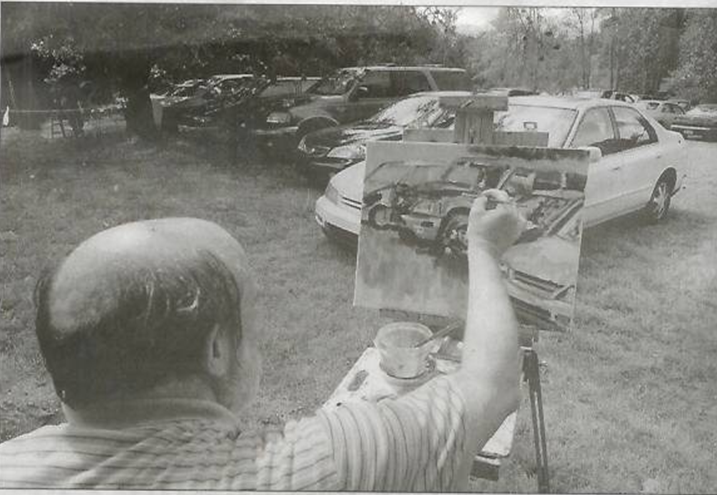
I told my students we could go there and paint, but I would just stay in the parking lot and do paintings of the cars. That’s just what I did. There were around a hundred artists there. We all painted for a few hours, then our paintings were judged. Guess what? I got third place. That’s kind of funny, considering I was being stubborn and didn’t want to paint what everybody else did. Here is the photo of me from the newspaper article as I painted:

me painting.png

I used the technique I always use. Instead of thinking about painting cars, I looked for shapes. I saw shapes of light blue, of dark green, of brown, etc. I drew the shapes on the canvas, then filled them in with the colors. It worked again like putting together a puzzle. Keep in mind I only worked on this for about two hours.

parked-cars[1].jpg

Maybe I was stubborn, but at least I had fun.

6

When I teach my classes I always begin by doing a demo of the subject I am trying to teach. Here are two of them:

bananas[1].jpg

Whenever I do a still life I light the subject with a lamp so I’ll have shadow and light. I draw the scene on the canvas. I draw each shape I see, like the shapes of shadows or of light. For example, I draw the shadowed areas of the bananas, then the lighted areas. Once the drawing is in, I begin painting. When I paint I don’t think “I’m painting a banana”, instead I think “that shadow shape has a blue tint to it,” so I’ll paint that. Then I might think “there is a blue-green shape” and I’ll paint it, instead of thinking I’m painting the edge of a plate. The cloth is white, but with the yellow light shining on it I put a yellowish tint. If you think about it, my process is like putting together a puzzle: I paint shapes and colors and they eventually come together as a picture.

Here is another class demonstration:

heading-home[1].jpg

I’ve done some cars driving past the Indiana State Capitol building. I use linear perspective. There is a vanishing point around the left-center of the picture. The road comes from that point – the left side comes almost straight down and the right side is nearly horizontal. The cars are drawn in the same way with their left and right lines. You also see them driving up the street using atmospheric perspective.  The closer cars are bigger and more detailed while the ones further up the road are smaller with very little detail. You will note the sunlight on the right side of the capitol dome and the yellowish tint on the road. These things, as well as the color of the sky and the shadows on the ground, suggest it is late afternoon.

17

My wife and I flew to London. We landed at the Gatwick airport, took the Gatwick Express commuter train from the airport to Victoria Station, then rode the tube (subway) east to the Tower Hill station. We exited, then went across the street to the Grange Hotel and checked in. Our son-in-law lived with our daughter in Cologne, Germany but during the week he often worked in London and stayed in the Grange, so we actually got to stay in his hotel room.

I was flabbergasted when I looked out the hotel window – there, right before my eyes, was the Tower of London with Tower Bridge and the Thames River right behind it! I love the Tower of London. It is such a fascinating complex with it’s Yeoman Warder (Beefeater) guards. It has the famous White Tower which was built by the Normans who invaded in 1066, as well as the location where Anne Bolyn was imprisoned and executed. The Tower Bridge is commonly mistaken for London Bridge. It is one of the most famous structures in London. It is the two big structures in the rear of the painting. I could go on and on – I absolutely adore London.

I decided I needed to paint the scene.

the-tower[1].jpg

With this scene there was so much detail that I thought I’d get lost. I actually ended up gridding my canvas and painting in each grid individually so I could keep track of everything.

Another point I need to make has to do with atmospheric perspective. With atmospheric perspective, warm colors come forward and cool colors recede. What that means is that the green colors that are closer to the viewer are greener the closer they are, but if there is a green in the far background, they fade to a light bluish tint. You can see that with the trees near the castle wall.  They are very green. In the background the green countryside fades to more of a bluish tint. Also, the actual structures that are nearby are painted with much detail, but buildings far in the background have little detail at all and their colors are faded. Atmospheric perspective gives a feeling of depth – you can look deep into the painting.

3

My last one-man show featured portraits of prominent residents of Northville, Michigan, however they didn’t know it was going to happen. A few months prior I had gone about town taking photos of individuals. All they knew was I needed their photo for a project for one of the galleries. I painted portraits from the photographs. I tried to have something in the backgrounds relating to the individuals. You can see several of the portraits if you click on “Most Recent One Man Show” on the gallery section of the website.

The individuals received special invitations to the show. They were surprised to see themselves on the gallery wall when they arrived.

The gallery produced post card invitations to be sent to the regular mailing list. Sara Marlowe, gallery director, created the image for the card by including pieces of several of the portraits – an eye, a nose, etc.  The invitation created a lot of interest and gossip.  Here is the invitation card:

postcard-invitation[1].jpg

This is the police chief for Northville. I had to beg the receptionist to get him for me. He came out of his office and reluctantly posed for the picture. I’m sure he thought I was up to no good.

It is very hard to paint a portrait from a photo. A lot of people try to do it. For one thing, a photo will pick up the yellow artificial light from the bulbs above. Another thing is that the person is flat on the photo. I had to study these photos carefully so I could get the actual three dimensional feel. I forced some of the shadows and light on the faces to give that impression. This man’s hair is painted straight white. It isn’t that way normally, but with the light from above, any differences were washed out. Note the light and shadows on his shirt. There  are different colors. The colors happen  because of the sources of light. The blue parts have natural light coming from the outside entrance, while the greenish shades happen with the yellow cast of the overhead lighting.

Tell me what you think of my portraits in the “Most Recent One Man Show” section.  Which one do you like best?

4

Portraits are probably what I enjoy doing the most. In college I studied skull structure and had very intense portrait drawing and painting classes.

portrait[1].jpgThis is a portrait of my beautiful mother-in-law. I had her sit at the long end of our dining-room table.

You will notice that I had lighting at one side which I always do so that I can have a contrast  between shadow and light. You can detect which side has the light by looking at the white hair on the left side vs. the bluish looking hair on the right, and the highlight on the left side of her lip.

When I do a portrait I draw the outline of the face first, then I squint to see the outlines of shadowy areas. I mix three different shades of flesh color, a dark one, a medium, then a light. A typical color scheme for flesh might be alizarin crimson, yellow ochre and white. I ‘ll do one that is pretty dark,  then use the same mixture but add more white to get a medium, and finally one that is much lighter with more white. As I start putting in the paint I will put the darkest shade in where the shadows are.  Next I’ll find the very light areas. I’ll put the medium shade in whatever is left.

In this painting I have yellow light from an indoor light bulb, so the lighter areas on the skin will have a slight yellow shade. You’ll see that the left side of the dress is not only lighter, but has that yellow tint from the light bulb. IMPORTANT–Always be sure to paint the whites of the eyes the color that you see, not plain white. Her brows shade her eyes. The whites are shadowed.

self-portrait[1]_1.jpgThe scary portrait you see next is me. The funny thing about it is that I painted it at home. I needed a mirror to look in and my easel wouldn’t fit in the bathroom. There is a long, skinny mirror on the back of my bedroom door, so I used it. You would have laughed if you had seen me leaning to the left or to the right to be able to see enough of myself in the mirror so I could do my painting.

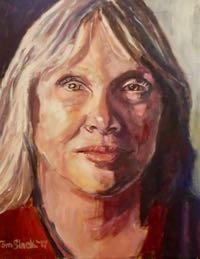
You will notice the light side and the shadow side which is very important in a painting. Another thing you should notice is the background. It is light on the right side and dark on the left. Look at  how my shirt blends right into the dark background. You may not have noticed this before. Your mind automatically tells you that the shirt is all there, but it isn’t.