17

My wife and I flew to London. We landed at the Gatwick airport, took the Gatwick Express commuter train from the airport to Victoria Station, then rode the tube (subway) east to the Tower Hill station. We exited, then went across the street to the Grange Hotel and checked in. Our son-in-law lived with our daughter in Cologne, Germany but during the week he often worked in London and stayed in the Grange, so we actually got to stay in his hotel room.

I was flabbergasted when I looked out the hotel window – there, right before my eyes, was the Tower of London with Tower Bridge and the Thames River right behind it! I love the Tower of London. It is such a fascinating complex with it’s Yeoman Warder (Beefeater) guards. It has the famous White Tower which was built by the Normans who invaded in 1066, as well as the location where Anne Bolyn was imprisoned and executed. The Tower Bridge is commonly mistaken for London Bridge. It is one of the most famous structures in London. It is the two big structures in the rear of the painting. I could go on and on – I absolutely adore London.

I decided I needed to paint the scene.

the-tower[1].jpg

With this scene there was so much detail that I thought I’d get lost. I actually ended up gridding my canvas and painting in each grid individually so I could keep track of everything.

Another point I need to make has to do with atmospheric perspective. With atmospheric perspective, warm colors come forward and cool colors recede. What that means is that the green colors that are closer to the viewer are greener the closer they are, but if there is a green in the far background, they fade to a light bluish tint. You can see that with the trees near the castle wall.  They are very green. In the background the green countryside fades to more of a bluish tint. Also, the actual structures that are nearby are painted with much detail, but buildings far in the background have little detail at all and their colors are faded. Atmospheric perspective gives a feeling of depth – you can look deep into the painting.

3

My last one-man show featured portraits of prominent residents of Northville, Michigan, however they didn’t know it was going to happen. A few months prior I had gone about town taking photos of individuals. All they knew was I needed their photo for a project for one of the galleries. I painted portraits from the photographs. I tried to have something in the backgrounds relating to the individuals. You can see several of the portraits if you click on “Most Recent One Man Show” on the gallery section of the website.

The individuals received special invitations to the show. They were surprised to see themselves on the gallery wall when they arrived.

The gallery produced post card invitations to be sent to the regular mailing list. Sara Marlowe, gallery director, created the image for the card by including pieces of several of the portraits – an eye, a nose, etc.  The invitation created a lot of interest and gossip.  Here is the invitation card:

postcard-invitation[1].jpg

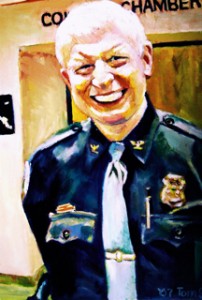
This is the police chief for Northville. I had to beg the receptionist to get him for me. He came out of his office and reluctantly posed for the picture. I’m sure he thought I was up to no good.

It is very hard to paint a portrait from a photo. A lot of people try to do it. For one thing, a photo will pick up the yellow artificial light from the bulbs above. Another thing is that the person is flat on the photo. I had to study these photos carefully so I could get the actual three dimensional feel. I forced some of the shadows and light on the faces to give that impression. This man’s hair is painted straight white. It isn’t that way normally, but with the light from above, any differences were washed out. Note the light and shadows on his shirt. There  are different colors. The colors happen  because of the sources of light. The blue parts have natural light coming from the outside entrance, while the greenish shades happen with the yellow cast of the overhead lighting.

Tell me what you think of my portraits in the “Most Recent One Man Show” section.  Which one do you like best?

4

Portraits are probably what I enjoy doing the most. In college I studied skull structure and had very intense portrait drawing and painting classes.

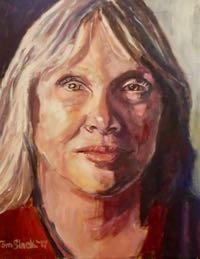
portrait[1].jpgThis is a portrait of my beautiful mother-in-law. I had her sit at the long end of our dining-room table.

You will notice that I had lighting at one side which I always do so that I can have a contrast  between shadow and light. You can detect which side has the light by looking at the white hair on the left side vs. the bluish looking hair on the right, and the highlight on the left side of her lip.

When I do a portrait I draw the outline of the face first, then I squint to see the outlines of shadowy areas. I mix three different shades of flesh color, a dark one, a medium, then a light. A typical color scheme for flesh might be alizarin crimson, yellow ochre and white. I ‘ll do one that is pretty dark,  then use the same mixture but add more white to get a medium, and finally one that is much lighter with more white. As I start putting in the paint I will put the darkest shade in where the shadows are.  Next I’ll find the very light areas. I’ll put the medium shade in whatever is left.

In this painting I have yellow light from an indoor light bulb, so the lighter areas on the skin will have a slight yellow shade. You’ll see that the left side of the dress is not only lighter, but has that yellow tint from the light bulb. IMPORTANT–Always be sure to paint the whites of the eyes the color that you see, not plain white. Her brows shade her eyes. The whites are shadowed.

self-portrait[1]_1.jpgThe scary portrait you see next is me. The funny thing about it is that I painted it at home. I needed a mirror to look in and my easel wouldn’t fit in the bathroom. There is a long, skinny mirror on the back of my bedroom door, so I used it. You would have laughed if you had seen me leaning to the left or to the right to be able to see enough of myself in the mirror so I could do my painting.

You will notice the light side and the shadow side which is very important in a painting. Another thing you should notice is the background. It is light on the right side and dark on the left. Look at  how my shirt blends right into the dark background. You may not have noticed this before. Your mind automatically tells you that the shirt is all there, but it isn’t.

8

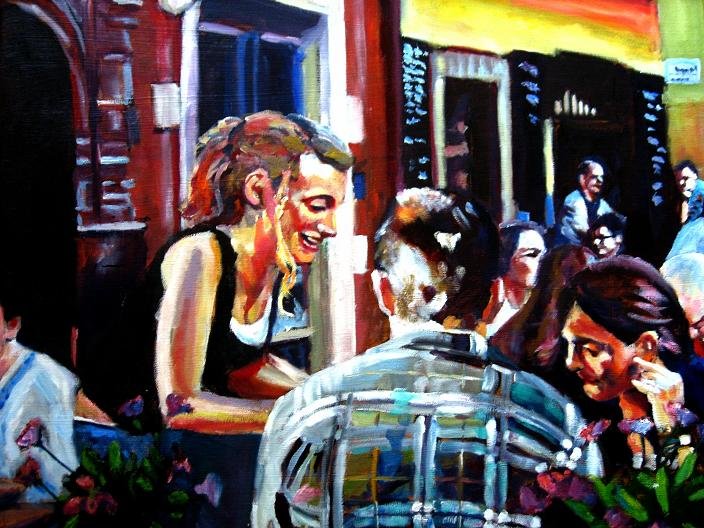
I love to do figurative paintings. Whenever I paint a group of people I like to have them in different places on the canvas, not just in a line–“Hey everybody, look at us pose!!” It is much more interesting having people in front and in back with different gestures. Notice the highlights from the sun on parts of the figures. The people closest at the front are more defined than the ones at the top left who are further away.

I might mention that the woman holding the little boy’s hand is my daughter, Sarah. She is holding her nephew’s (my grandson’s) hand. The girl at the bottom is her niece (my granddaughter) and the boy she is with is Sarah’s  son (also my grandson). They are at an amusement park in the Netherlands.

stepping-stones[1].jpg

5

I’m a fanatic fisherman. I’ve fished from coast to coast and have caught all kinds of trout, bass, bluegills, crappies and some fish that I couldn’t recognize.

This is a self-portrait. I’m standing in Sugar Creek in central Indiana. Notice the reflections in the water. Can you see me upside-down? There is a contrast between the dark shady trees and the sunny ones. This technique adds drama and interest to a painting.

7

I did two more paintings in Detroit last weekend. The first one shows a skyline. I have found that when doing a painting of buildings or other structures it works best to approach it from the side. By doing this you will get a feeling of perspective and volume because there is a shadow side and a light side. Also I like to include more than one building to show different angles. The building on the left side is put there to give the painting depth – it looks closer than the tall building in the center of the painting.

Highrise3.jpg

The second painting is a different type of cityscape painting. It doesn’t focus on a skyline, but instead, shows sections of buildings. The differences in colors and placement of windows differentiates the buildings. I have added my  little pet trick – putting cars in the picture to add interest. You will notice that there isn’t a lot of detail in the vehicles, only enough to let you know they are there.

One Way3.jpg

8

I wanted to paint something in the downtown Detroit area. I went to Greek Town. It has a lot of ethnic Greek establishments. There were Greek and American flags hanging over the street. Music was playing. It smelled great.

Pickup and Delivery.jpg

I got there early  in the afternoon. I did the painting with backlighting. This way the persons near the truck appear as silhouettes and the flags appear as light is showing through them. I used perspective so it looks like you can walk right down the street. These techniques give a magic or romantic feeling to the painting. I also suggest using a car or a person in a painting to add interest. You might have a very well painted scene, but without the car or person (or dog, horse, bird, etc) the scene is boring. The addition of these things adds interest.

9

Hi, everyone. I want to tell you about my art. I’ve wanted to be an artist my whole life, but everyone told me I shouldn’t. I listened to them. I was miserable. I did what everyone else told me to do. Finally, after a life-threatening experience I decided I owed it to myself to do what I wanted. I quit my job, got a swing-shift job making hotel reservations, and got my art degree. That was about ten years ago. Since then I’ve had nothing but  fun and fulfillment. I want to explain my techniques and talk about my art.  You’ll be hearing from me regularly.